
What "Shepherdman" Means
Shepherdman is a name of Shinjun Mikami's own making, from "shepherd." It describes the stance he takes toward the people who learn from him: he steps in front when guidance is needed, walks beside them as they go, and steps back once he is no longer needed. Shepherdman Academy is his place for anyone who wants to learn from him, and that stance is how he teaches here.
Why Praxis, and not practice
In English, a practice can mean a thing you take up for a while and put down again. Praxis is the word we use for the other sense of it — the one that lasts the length of a life, and has no finish line.
It starts with a form that is not yours. You copy it, badly at first. In time it stops being a thing you are copying and becomes the way you do it. Later still, it stops being a technique at all and is simply the way you go about things.
Someone else's kata → my praxis → my michi.
Kata is the form. Praxis is the daily work of it. Michi — a way, a road — is what is left when the work has been done long enough that it no longer looks like work.
Five areas
What is practiced here falls into five areas. They are not levels to climb; they run alongside each other.
- Self
- Putting yourself in order — the body, the mind, your habits — and looking honestly at your own state.
- Kata
- Form. Courtesy, repetition, and the discipline of doing a thing the same way, again and again.
- Praxis
- The daily work: practice, action, and the judgment that comes out of both.
- Others
- Helping, listening, guiding, protecting. Practice that stops with you is unfinished.
- Michi
- Your own way — what you are for, and how that meets the world you live in.
Growth that benefits only the person doing it is not complete. That is why Others is not an afterthought at the end of the list.
Tell someone not to think, and they think
This is the honest difficulty with sitting still. The instruction is to stop thinking, and the instruction itself becomes another thought. The mind works hardest when the body is doing nothing.
So we move the hand. The hand is given one simple task, and attention follows the hand rather than chasing itself.
That is why the practice we begin with puts a brush in your hand. It is called Brush Praxis.
The System
Two things are often called by the same name. They are not the same.
- Meditation
- Seeing what is present, without a goal.
- Contemplation (kanso)
- Practice with a direction.
The foundation of both is the same, and it is plain: breath work, and breath counting (susokukan). Breathe, count, notice that you have drifted, come back. Noticing the drift and coming back is not a failure of the practice. It is the practice.
Beyond the foundation there is deeper practice. It is not something you sign up for. It begins only after teacher and student have come to know each other, and both decide to begin. The way in is always the foundation.
Shinjun Mikami
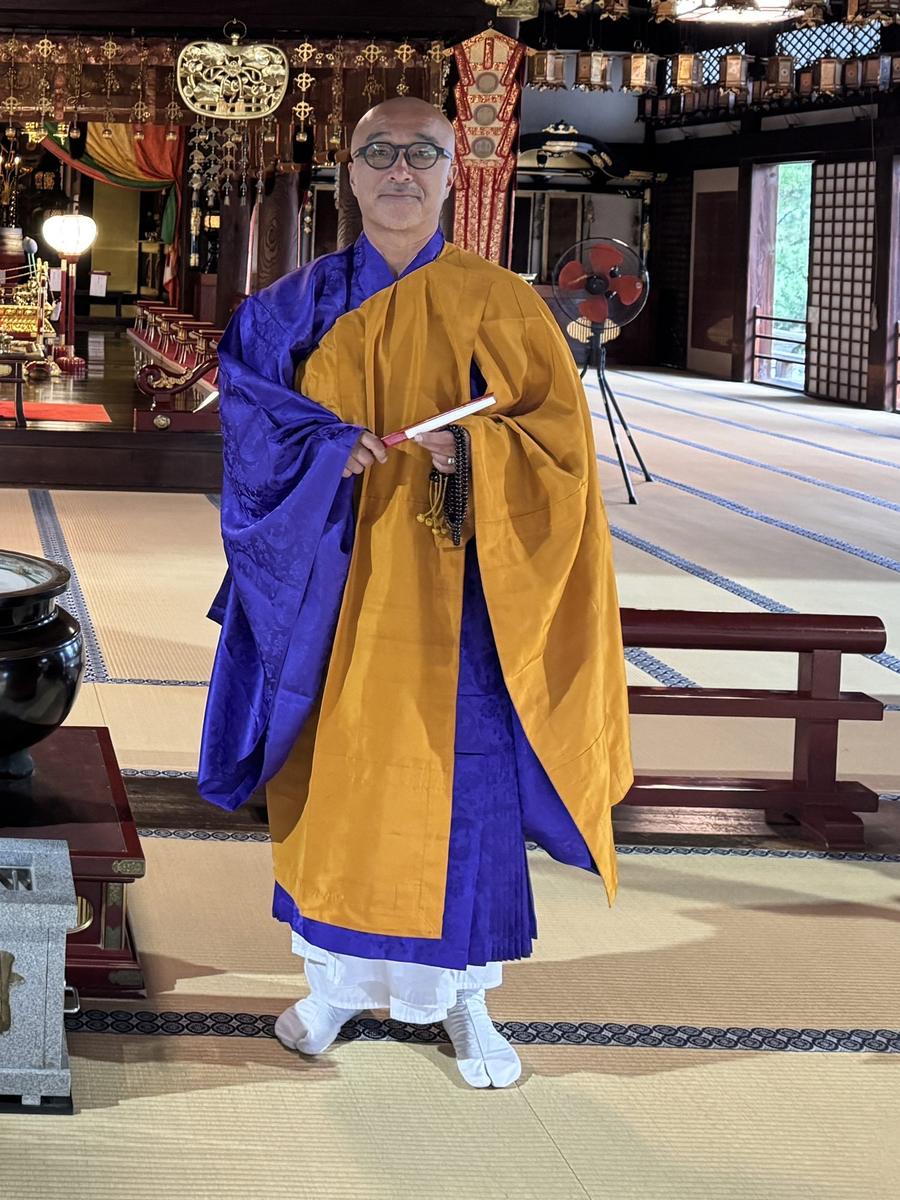
He has held practice in two places — in Japan, and, formerly, in California, in the San Francisco Bay Area.
His path in America began at Washington State University, studying psychology. He also completed non-profit management study at Harvard Kennedy School.
-
2008
He served as Japan representative for NASDAQ Pacific Net (U.S.), and now serves in the same role for a law firm in California.
-
2015
He is TESOL certified, has taught at US universities, and interpreted in legal and international settings.
-
2016
He is a US-registered clinical chaplain, and holds shihan certification in brush practice from the Japan Onore-sho Dojo association.
-
2021
He received the rank of Denbo Daiajari in 2021.
A Shingon Buddhist priest, he also serves as Chair of NPO Heart Spot and Representative Member of AwesomeSea LLC.
That range grounds this practice. MIKAMI ENGLISH ACADEMY grew out of his work in English.
Dates for upcoming sessions are announced on Instagram, and on the LINE account for those in Japan. To ask about anything else, use the contact form.